

Protect the historic center of Venice. An integrated reading of physical and perceptive wear and tear processes for the definition of mitigation actions.

Abstract. The aim of the research is to identify the "physical" and "perceptual" wear factors to which the Historical Center of Venice is subjected (with particular attention to the effects of anthropic pressure related to the phenomenon of tourism) and the assessment of their level of danger in order to determine criteria and tools of mitigation and control.
The research is one of the actions of the action plan "Protection and conservation of heritage" provided by the UNESCO Management Plan of the site "Venice and its Lagoon". Through a systemic reading and an analysis of the forces of modification in place, the research identifies the "macroemergencies", that is, the main factors that have a negative impact on the preservation of the site. The research project "Assessing the wear and tear processes and criticalities of the City of Venice and its Lagoon and its impact on the protection of the site" is part of the actions provided by the Management Plan of the UNESCO site of Venice and its Lagoon1. The main objective of the project was to identify the factors of greater wear and tear, physical and perceptual2, to which are subjected the historical and artistic assets of the Historical Center of Venice, with particular attention to the effects of the anthropic pressure linked to tourism, and the evaluation of their level of danger. Another objective of the research activity was to identify measurable parameters (indicators) for monitoring and, subsequently, strategies for mitigating the most significant phenomena. Keywords: Historical Center of Venice, UNESCO Site Management Plan, Heritage Protection and Conservation, Wear Factors, Mitigation and Control Tools
The research project was developed through the breakdown of the activity into successive phases according to the following operating scheme:
- analysis of bibliographic sources and state of the art construction;
- construction of the framework for the analysis of wear processes;
- identification of physical and sociocultural dynamics, as well as systemic correlations and interrelationships that determine, at various levels of intensity, the wear processes;
- identification of measurable parameters and significant criticalities for reading the effects of wear.
It was therefore necessary to collect and systemize a large amount of documents and data, in order to arrive at the identification of the main critical cores for the protection of the site.
The activity has been complex for various reasons: firstly, for the articulation and scale of the object of investigation; secondly, for the richness of the existing material and the large number of previous researches; finally, for the multiplicity of actors, institutional and non-institutional, operating on the site and depositors of information and data necessary for the purposes of research.
In this context, a first important objective achieved was the organisation of a complete archive of sources, in digital format, organized by field of investigation, which put into system a considerable amount of information that, although available, were dispersed, sometimes little known or not accessible.
The second phase of the research was directed to the study of the main wear and tear phenomena, natural and anthropic, which affect the Historical Center.
The study has revealed its complexity and in some cases also the difficulties of evaluation, not only because they are elusive, but also because they are strongly interrelated. This therefore required particular attention to be paid to relations between phenomena in order to identify the main risk factors associated with their mutual interaction. In addition to the description of the dynamics of manifestation and development of wear and tear phenomena, research has addressed the theme of monitoring risk factors and their mitigation.
In light of the objectives of protection, conservation and sustainable use of the city of Venice, and of the context of reference, the main phenomena tending to usury detected (i.e. that they cause alterations of the system balances and loss of matter and/or of meaning of the urban fabric) are: the problem of high water, the wave of wind and water traffic, the pollution, the degradation of the residential structure and the paving 1).
The definition of phenomena took place both through direct detection and collection of statistical data, and through the acquisition of previous researches, which gave evidence of some changes in the system otherwise not directly perceived.
Given the stratification of possible levels of reading and interpretation of the Venetian urban system, it was necessary to introduce an additional level of description to highlight the interdependence existing between different phenomena.
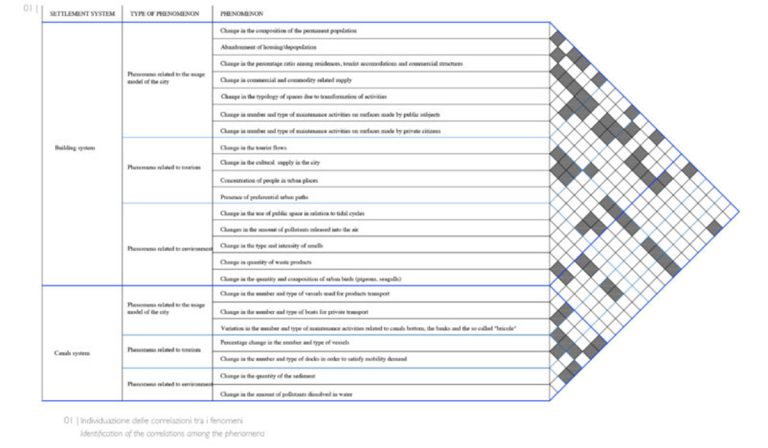
These interdependences, represented by correlations between the individual phenomena, express both the potential risk conditions associated with dynamics not yet in place or wearable actions not yet manifest, both the multiplier effect and the wearable action of a phenomenon causes, cascading, on others.
The relationship between phenomena is not, in fact, direct and biunivocal, but rather systemic; this means that the result of the interaction between two phenomena is not equivalent to the sum of the same but produces much more complex effects on the whole system.
The articulation of phenomena and the identification of their correlation are graphicalized through the construction of a matrix (Fig. 1).
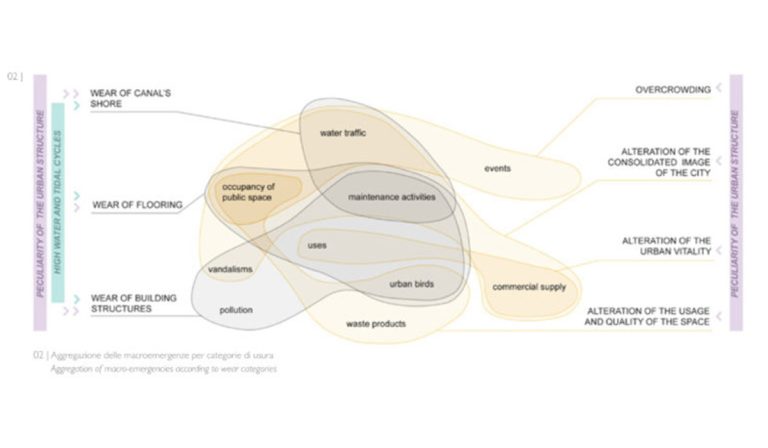
Phenomena and correlations contribute together to determine one or more "macroemergencies". The term macro-emergency refers to a new collective entity4 in which the properties of the interacting elements are coherent, as well as detectable at a higher level of description, i.e. macroscopic, than that used for its individual components. The macro-emergencies therefore represent new keys to reading the built system, to which only some of the phenomena and their correlations previously identified, selected according to their response to the theme from time to time investigated.
The macroemergencies can be aggregated in wear categories, according to a common denominator represented by the existence of wearable actions acting on the same parts of the system (Fig. 2). Although wearable actions represent the tangible manifestation of the macroemergencies on the built system, they have not always been measurable. In fact, perceptive wears do not always have a quantifiable physical nature, but they translate into negative perceptions, unsatisfied expectations, inconveniences, dissonances or inadequacies that, necessarily, suffer from the expectations and cultural conditioning of the observer.
The final objective of the analytical process adopted is to achieve an in-depth knowledge of the dynamics of transformation of the Historical Centre to determine what actions to take to counteract the processes of wear in place, with the awareness that, acting on a problematic node, the repercussions could also occur on other elements of the system according to the same logic of multilevel interdependence already described.
In general, however, if in the case of already manifest effects (current risk conditions) it is necessary to foresee both monitoring actions and appropriate mitigation actions, in the case of expected effects (potential risk conditions) it may be enough to activate an effective monitoring and prevention program.
The understanding of wear processes, manifests or expected, required an in-depth analysis of the evolutionary dynamics of the site and the identification of the probable causes of degradation. In a complex system, however, the relationship between detected effect and wear process has not always been identified in a clear and unique way.
To the different levels of reading, in fact, the conditions in place were:
- strongly interrelated among themselves;
- overlapping with multipliers or mitigative effects;
- belonging simultaneously to multiple wear categories;
- expression still not fully manifest of a wearable action potentially active on the site or on part of it.
In order to overcome this complexity, the information has been organized in such a way as to facilitate the reading of the urban system in transformation, maintaining the same articulation of the arguments here assumed within the concept of macro-emergency (water traffic in the channels, large ships, maintenance interventions, audiences and postages, events, destinations of use, commercial offer, vandalism, pollution, waste, urban avifauna).
With different levels of study, depending on the availability of data or the completeness of the information collected, analytically illustrated the current characteristics of the urban system and the peculiarities that can be seen in the evolution of the different phenomena mapped, through statistical data, trend of growth or involution, graphic design specially built to make more explicit some aspects particularly relevant or some of the interrelations existing between the different phenomena.
The evaluation of wear processes shows that the main criticalities arise from the fact that over the years some internal balances of the lagoon have been profoundly modified, determining new models of use of the entire system (channels and built system.
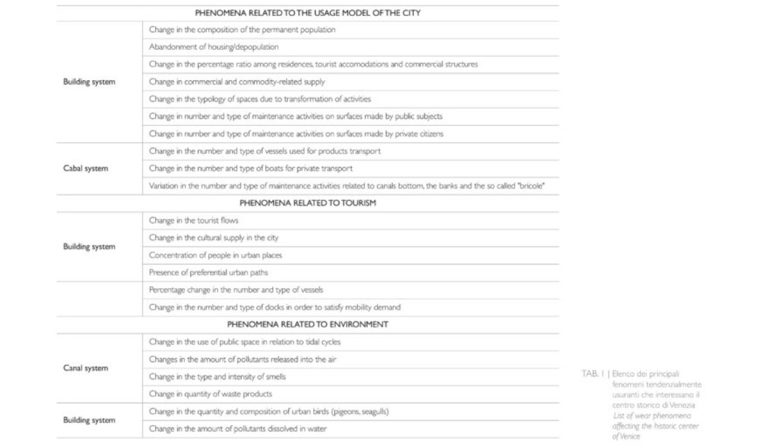
All the phenomena that have been considered relevant from the point of view of wear have been analysed.
They were evaluated in two ways: first divided into two macro areas of description, through which the peculiarities of the Venetian land structure are highlighted, that is, the system built and the system of channels, and then divided into three other typological classes (phenomenes connected to the models of use of the city, phenomena connected to tourism, phenomena connected to the environment) that are able to define, in a synthetic way, what phenomenon is prevalent.
To complete the analysis carried out, some hypotheses, still provisional, relating to possible mitigation interventions were identified.
The research, in fact, given the vastness of the themes addressed, already previews a second phase in which will be developed, on an experimental basis and on some significant pieces of the Old Town, a detailed analysis of the urban transformations occurred. This will allow experimental confirmation of trends that have been detected on a documentary or statistical basis and, at the same time, to complete the data base still missing.
Mitigation actions mean actions aimed at reducing impacts generated by phenomena that represent a risk factor for a given territory (i.e. the macro emergencies described above).
The transition from risk factor detection to project and mitigation actions, however, must necessarily be mediated by a continuous and punctual monitoring activity, which is the crucial step through which the information necessary to the responsible authorities is acquired, and other stakeholders of interest, to assess the effectiveness of strategies in achieving the objectives set out, and to suggest, modify or adapt processes and actions.
The development of monitoring activities requires the identification of significant indicators, relating both to the conservation conditions of the site, and to the evolution of the risk factors in place and to the evaluation of the effectiveness of the management strategies already implemented with respect to the objectives of protection and conservation, in order to put into place any corrective measures and further mitigation actions.
In the monitoring system in part hypothesized by the Management Plan, however, a critical factor can already be seen in the fragmentation of competences between multiple bodies and institutions and in the specificity of the parameters identified for the measurement of phenomena, to the detriment of a systemic reading of the phenomena themselves. This, however, derives from an inherent criticality to monitoring activities, i.e. the difficulty of measuring complex phenomena, which have fallen on the observed system of both quantity and quality.
In any case, in order for the monitoring to be effective, it must not remain an end to itself, but its results must produce positive feedback by acting on the redefinition of management strategies: this obviously requires an interpretative, evaluative and design action by the managing body.
In other words, the results of monitoring will have to influence the definition of public programmes and policies aimed at protecting and preserving the site according to the principles of safeguarding the identity and authenticity of the Old Town of Venice.
Bruttomette, R. (Ed.) (1997), 66-96 Laboratorio Venezia. Maintenance, safety, urban quality, Marsilio, Venice.
Hackings, M. (2004), "Summary of Final Discussion – Vicenza Monitoring Workshop", in AA.VV. (2004), Monitoring World Heritage, World Heritage Papers #10, UNESCO World Centre and ICCROM, p. 118.
Office of Piano (2011), Sustainable Tourism in Venice. Knowledge analysis and first indications, thematic report.
AA.VV. (2007), Venice urban maintenance. Insula: 10 years of work for the city, Vianello, Ponzano Veneto.
Minati, G. (2004), General Theory of Systems. Systemic. Emergency: an introduction, Polimetrica, Milan.
Trovò, F. (2010), New Ancient Venice 1984-2001. Private building in the interventions ex lege 798/1984, Maggioli Editori, Segrate.
Gasparoli P., found F., fragile Venice. Urban wear processes and possible mitigation, Altralinea, Florence, 2014
CODELLO R., GASPAROLI P., RONCHI A.T., PIANEZZE F., TOTARO G., TROVÒ F., Protecting the historic centre of Venice. A coordinated analysis of the physical and perceived wear processes to define mitigating actions, in: TECHNE, Journal of Technology for Architecture and Environment, n° 7/2014 – Firenze University Press, ISSN 2239-0243 (online); pp. 75-80

