


Organized by Confartigianato Nazionale Restauro, it was held in Rome, on 23 October 2024, in the Spadolini Room at the Ministry of Culture, the Conference Designing the Restorations. The Role of Cultural Heritage Restorer".
An important theme, which has so far not been discussed, which concerns precisely the figure and role of the Restaur of BB.CC., as defined by the current legislation, as part of the restoration project.
- In support of the need for deepening, it is noted that:
the Public Works Bands of buildings subject to protection, but now also the Structured Authorities, require the presence in the Project Group and in the Office of Management Works of the figure of the Restoration of BB.CC. ; - the project and support activity to the DL is being configured for the Restorer enrolled in the ministerial lists pursuant to art. 182 and art. 29 Legislative Decree 42/2004, as far as competence is concerned, an operating area of sure interest that is added to the activity "core", that is, the activity of yard as operator.
This situation, introduced by the legislation, creates no longer eludible questions concerning the delimitation of the duties and responsibilities of the Restorer, in particular with regard to the Architects, as regards the theme of the treatment of the historicized surfaces of architecture, to which this contribution is in particular reported.
Finally, in the context of the more general motivations, it seems to be to be emphasized that the most frequent question concerns "how to restore itself, rather than why, neglecting that there is no sense in any technical operation independent of an end, from a scientific, ethical and cultural objective" (1) which should unite the intentions of the actors involved.
“The [project of] restoration is the execution of a project of architecture that applies to a pre-existence, performs on it all the technical operations suitable to preserve its material consistency, to reduce all the intrinsic and extrinsic factors of degradation, to give it to use as a tool of satisfaction of needs, with the changes strictly indispensable, using preventive study and project as tools of increase of knowledge” (2).
This states Amedeo Bellini in a text in which some of the best-known scholars on the subject were invited to propose a "definition" of restoration.
This by Bellini, among the different proposals, is the one that seems most acceptable (to those who write) for various reasons:
- that the restoration project is still a project of architecture; that is, it does not enjoy autonomous statutes but falls, precisely, within the disciplines of architecture;
- is aimed at preserving the material consistency of the factory;
- must ensure that needs are used and met;
- may also include alterations, if strictly indispensable and geared to compatible use.
So it is a complex operation that, as well as those who dedicate themselves to it, foresees the convergence of many knowledges such as architecture, engineering, and specialized ones such as restoration, firefighting, acoustics, safety, accessibility, systems etc.
Certainly in the context of historical buildings one of the fundamental themes is the preservation of the materiality of architecture that must be pursued in order to pass on to the future, with the maximum of identity and authenticity, what has been "transferred to us as a gift" (3) from the past.
But we know – and it still reminds us Amedeo Bellini – that even preservation is not an absolute.
In fact, satisfying needs through use (compatible), presupposes the evolution of buildings in harmony with the evolution of societies. The needs of users are constantly ineluctable transformation and therefore the buildings, in order to give positive answers to the needs, must necessarily be able to change, configuring the project on the historical built as a process of governing the transformation from the "reading" and the "weighing" from the values differently represented in them (cultural, economic, of use).
The legislation defines as follows the role and competences of the Restoration of BB.CC. :
“Maintenance and restoration operations on movable cultural assets and decorated surfaces of architectural assets are carried out exclusively by those who are restorers of cultural assets under the relevant legislation” (4).
“The Restorer of movable cultural goods and decorated surfaces of architectural goods, subject to the provisions of protection of the Code, is the professional who defines the state of conservation and implements a complex of direct and indirect actions to limit the processes of degradation of the constituent materials of the goods and ensure their preservation, safeguarding their cultural value. To this end, in the context of a coherent and coordinated planning of conservation, the Restorer analyzes the data relating to the constituent materials, the technique of execution and the state of conservation of the goods and interprets them; designs and directs, for the part of competence, the interventions; directly carries out the conservative and restoration treatments; directs and coordinates the other operators who carry out complementary activities to the restoration. He carries out research, experimentation and teaching activities in the field of conservation.” (5)
So, synthesizing, the BB.CC Restorer. is the professional who:
- defines the state of conservation of the Good, endeavours to limit degradation processes and safeguard its cultural value;
- analyse and "interpret" implementing materials and techniques;
- design and manage the interventions (as far as competence is concerned);
- carries out research, experimentation and teaching activities.
If you then go into the substance of Annex A to DM 86/2009, where it is specified in detail the activities characterising the profile of competence, in addition to what is briefly defined above, it is clear that the Restorer of BB.CC. :
- draw up the technical file pursuant to Article DM 154/2017;
- formulate the preliminary, final and executive draft on the good and the context;
- draw up the maintenance plan and the planned conservation plan;
- in the intervention phase defines materials, methodologies and types of operators; assumes the technical direction and operational direction within the office of management works, carries out technical tests, carries out the monitoring of the interventions carried out, participates in the inspections provided for in the plans of conservation programmed.
All this in collaboration with the professionalism of the art historian, archaeologist, architect, archivist, librarian, ethnoanthropologist, paleontologist, physicist, chemist, geologist and biologist.
A significant overlap of skills with the Architect is evident, although limited to the conservation activities of decorated and/or "historical" surfaces.
With regard to the subject of skills – a dispute that arose mainly between engineers and architects – it is noted that Article 52 of the RD 2537/25 stipulates that civil building works, which have an important artistic character, as well as the restoration and restoration of bound buildings, are the responsibility of the profession of Architect.
Also in numerous judgments of merit is confirmed the exclusive competence of the Architect in the design of interventions on buildings bound and in general on cultural goods and artistic historical interest.
There is no doubt that modern restoration is increasingly being carried out in a multidisciplinary field. But if multidisciplinaryism itself is an important conquest in the field of conservation and restoration, not always this new condition corresponds to a real sharing in the field of the right skills that accompany the complex exercise of restoration. In any case, it remains as the main prerogative of the Architect that of the drafting of the Architectural project, of the knowledge of the history of the artifact and the territory.
It is believed, in particular, that in the context of the project of reuse and requalification of historical architecture, the role of the Architect is still fundamental above all in the context of diagnosis, understood not only, or only marginally, as a reading of the conditions of physical degradation, but, above all, in the reading of the "prestations in being", that is, the utilities that the building still represents, today, regarding the new needs of use, in the difficult task to decide exactly how to correctly to decide what to preserve.
Given that the restoration project, like any architectural project, presupposes multidisciplinary contributions, and, therefore, the Restorer is obviously an active part – if nothing else because the role is defined by law – these considerations can be proposed:
- on the theme of the conservation of matter
the Restorer, as from legislation, defines the techniques, the state of conservation, analyzes the materials, designs and directs the interventions.
But the technique is not neutral: it is the daughter of the goal you want to achieve, it requires a critical act that cannot be resolved in the maximization of conservation because "it is not possible to preserve everything, however everything is transformed; some objects play their function by consuming; In some cases it is not technically possible to preserve, in other cases the stay contradicts real needs. So, the tendency to an integral preservation of documents has technical and ethical limits, these of a collective and therefore political nature” (6).
- on the competence of the Restorer in order to the decorated surfaces
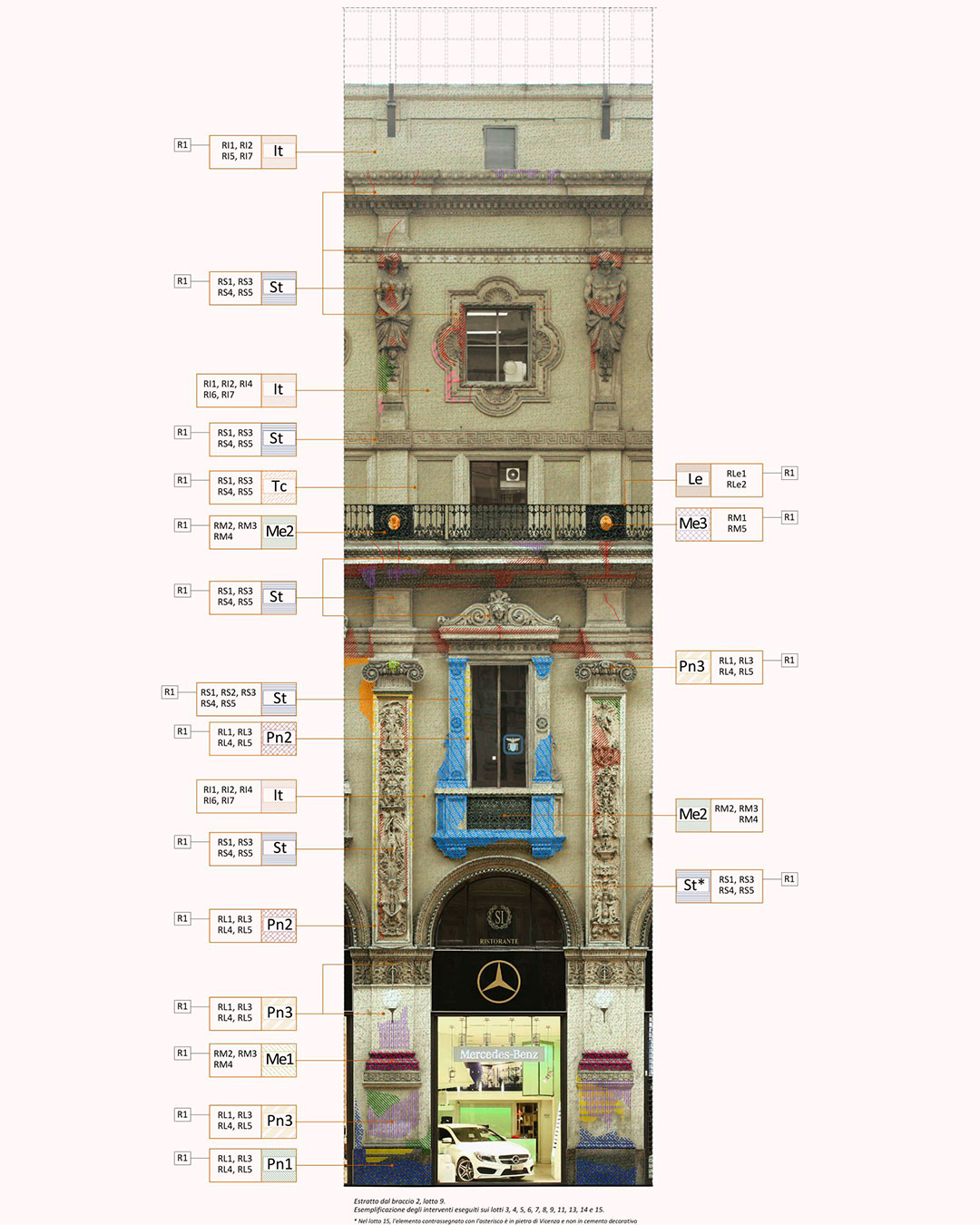
the surface, as defined by Ruskin, the last half inch of matter (7) – the one that transfers the consolidated image, which records the change (i.e. it carries on itself the signs of the passage of time), which degrades more quickly because in direct contact with the atmosphere and subject to anthropic actions – can not be separated from the support, it is an integral part of the wall apparatus and as such it should be considered. Moreover, in the context of the activities of restoration and conservation of matter, there is the theme of the integration of the "lacuna". This also requires a critical act – more properly related to the logic of the "design of the new" – which cannot be delegated to the Restorer alone.
Therefore, taking the normative aspects as factual data – and considering that the issue has never been regulated – it seems that the definition of skills in the relationship between Restorer and Architect should find solution in the context of a collaboration/comparison that appears obvious how trivial in its statement.
If it were simple, the problem would not have emerged that, on the other hand, it is highlighted half a voice at least by Architects who have developed specific skills in this professional field. In fact, sometimes the Restorer claims absolute ownership, while the Architect badly bears those he believes in field invasions.
On the other hand, the Restorer performs "supplements" and the Architect "delegates" willingly.
There is a question, therefore, whether in the context of everyday life there is a real conflict of competences or if, instead, the questions asked here are in fact more disciplinary than practical.
However, the theme of training remains ineludible. Today, that of the Restorer provides academic courses but also the role of the "cantiere" and the "bottega" as places of formation in the field, for support, as has always happened in history.
The considerations here advanced – however partial and provisional – require some reflections and comparisons between various actors and occasions for further refinement.
However, there are some more specific and certain marginal issues, but of a practical nature, which could help to circumscribe the tasks within the only restoration project, for example what should be the content of the draft projects produced by the Restorer in relation to those typically produced by the Architect or on how to define the relative professional compensation.
(1) B.P Torsello, What is restoration, Marsilio, 2005, p. 9
(2) A. Bellini in: B.P. Torsello, What is restoration, Marsilio, 2005, p. 24.
(3) "... God has lent us the land for our lives; he has given it to us in delivery but it does not belong to us. It belongs in the same way to those who must come after us whose names are already written in the book of creation ..."J. Ruskin, The Seven Lamps of Architecture, Jaka Book, Milan, 1981, p. 218
(4) Code of Cultural Heritage and Landscape (D.Lgs 42/2004), art. 29, paragraph 6.
(5) DM 86/2009, art. 1, paragraph 1,
(6) A. Bellini, op.cit., p. 23
(7) Rush

