Restoration of the Palazzo dei Giureconsulti: a dialogue between tradition and innovation

The restoration of the external surfaces of the Palazzo dei Giureconsulti, carried out between July 2020 and April 2022, during the COVID period, has developed from a preliminary phase of very articulated studies and executive design (it was in fact an integrated contract on call CCIAA and won by Gasparoli Srl with Studio Feiffer & Raimondi). During the final design phase, provided by the Authority, a laser scanner relief was made to obtain a 3D model of the building. However, in order to enrich this model with more detailed information, the designers appointed by us decided to further deepen the relief through the use of digital photogrammetric techniques. These techniques, combined with the use of drones for the collection of images, allowed the production of scale orthophotos, in HD, later integrated in the BIM model. This approach allowed an advanced information and geometric representation of external surfaces.
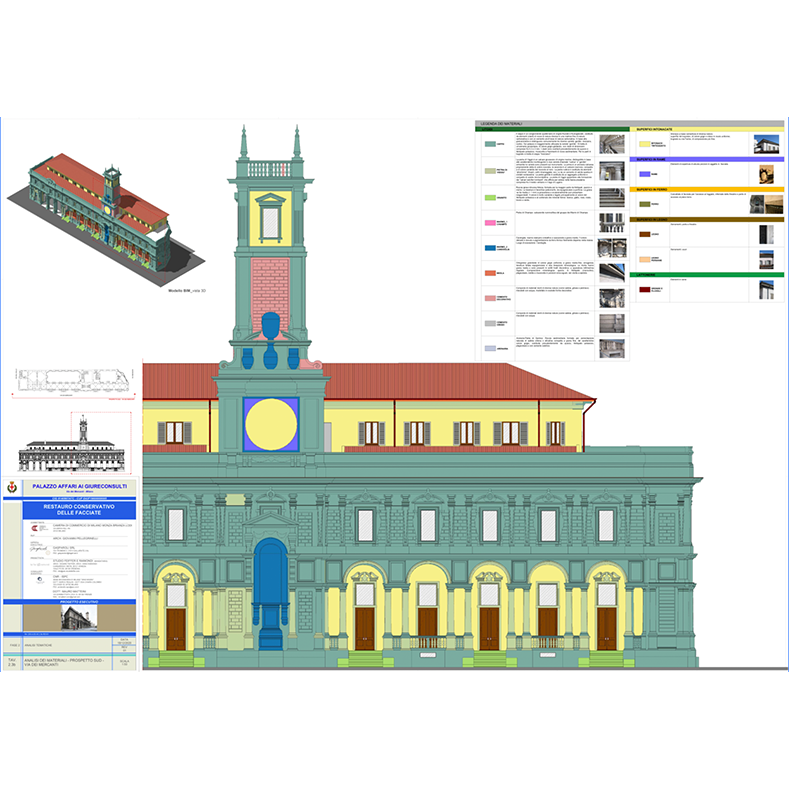
The building has a covering in stone materials of various nature. Among the main materials used is the Ceppo dell’Adda, which is a quaternary river conglomerate with different varieties (gentile, mezzanine and rustic). The variety "gentile" is mainly used for the moulded parts, of the "half" or "rustic" for the wall vestments. The reference quarry of this material is located between Paderno d’Adda and Trezzo. Another widely used material is the Pietra di Viggiù, a Jurassic limestone of marine origin present in the rustic and gentle varieties. The binate columns and arcades of the portico are made of "rustic" variety, while the balustrades are in the "gentile" variety. Moreover, there are marbles of the lower Ossola Valley, such as the Marble of Candoglia, used for the central statue of St. Ambrose and some sculptural decorations of the façade, and the Stone of Sarnico. Finally, on the side of Via Farine, plastered surfaces are found, with plasters of different nature and finish, such as those of uniform grey colour of the top and those rusticated in the base part.
The building has a covering in stone materials of various nature. Among the main materials used is the Ceppo dell’Adda, which is a quaternary river conglomerate with different varieties (gentile, mezzanine and rustic). The variety "gentile" is mainly used for the moulded parts, of the "half" or "rustic" for the wall vestments. The reference quarry of this material is located between Paderno d’Adda and Trezzo. Another widely used material is the Pietra di Viggiù, a Jurassic limestone of marine origin present in the rustic and gentle varieties. The binate columns and arcades of the portico are made of "rustic" variety, while the balustrades are in the "gentile" variety. Moreover, there are marbles of the lower Ossola Valley, such as the Marble of Candoglia, used for the central statue of St. Ambrose and some sculptural decorations of the façade, and the Stone of Sarnico. Finally, on the side of Via Farine, plastered surfaces are found, with plasters of different nature and finish, such as those of uniform grey colour of the top and those rusticated in the base part.
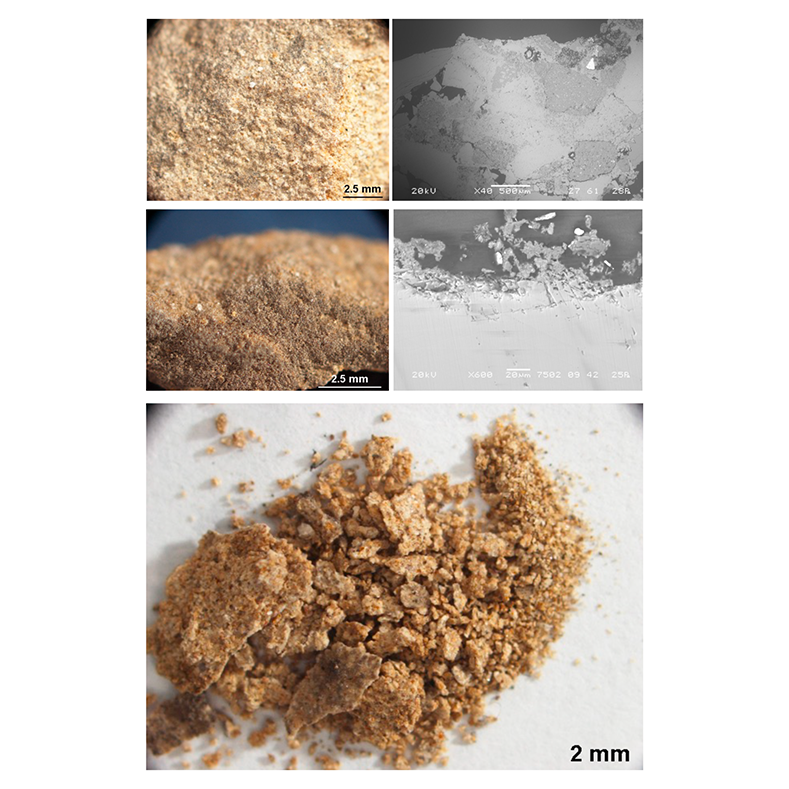
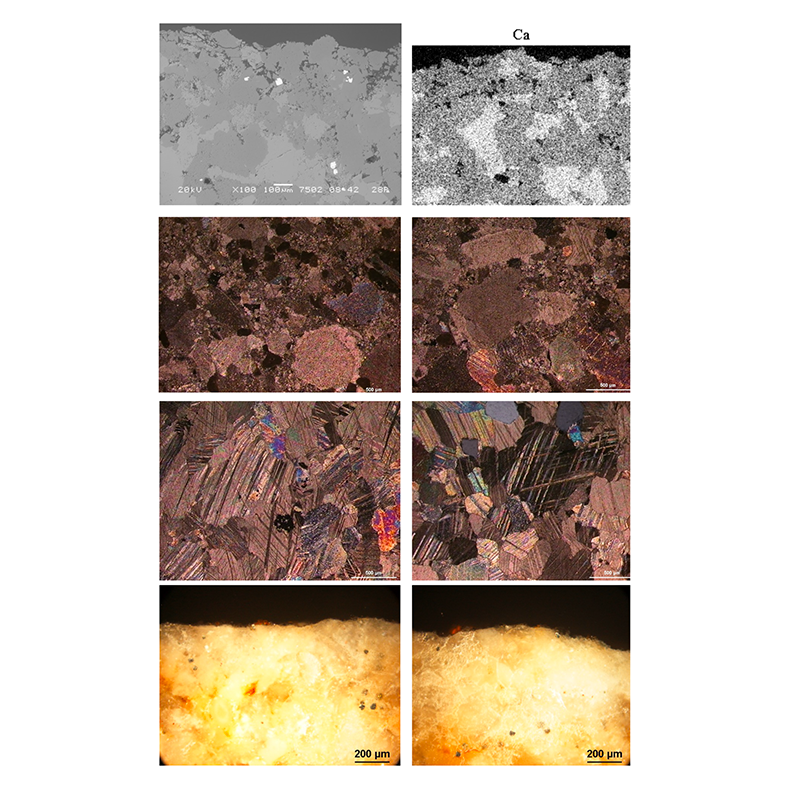
Once the scaffolding was installed, an expert petrographer, Dr. Roberto Bugini, has carried out the visible and analytical recognition of materials, allowing the mapping and analysis of degrades, then inserted in the BIM model. Further technical and scientific studies were also launched with the collaboration of Professor Mauro Matteini and ISPC-CNR. These studies concerned in particular the two most common lithotypes, namely the Ceppo and the Pietra di Viggiù. The analyses included advanced diagnostic methodologies such as stereomicroscopy, X-ray diffraction (XRD), optical electron microanalysis microscopy (SEM+EDS), IR and Raman spectroscopy, ion chromatography. Chromatic changes over time with colorimetry and porosity variation were also evaluated. Videoendoscopics were then performed to verify the efficiency of the embedded rainwaters.
From a conservative point of view, the condition of the outer surfaces was very different according to the materials, their processing, the position and the exposure to atmospheric agents. Environmental conditions, such as building orientation, shading, sun exposure and proximity to vehicular traffic, have significantly affected degradation. The surfaces were everywhere affected by deposits of atmospheric particle, black crusts and guano, with greater intensity on the façade overlooking via Mercanti, due to the presence of the ventilation grids of the underground below. The strain also showed widespread disintegration, fractures, erosions, pulverization and injuries. The columns in Viggiù Stone were generally in good condition, while the balustrades showed signs of exfoliation and loss of material. The plasters, in particular those on the shadow side on Via Farine, had swellings, detachments, saline efflorescences and capillary rising humidity. Finally, the few bronze surfaces were affected by corrosive processes. In addition, organic products applied during previous restorations (1985-1990) had undergone evident ageing, which had compromised their effectiveness and in some cases had worsened the degrading phenomena.
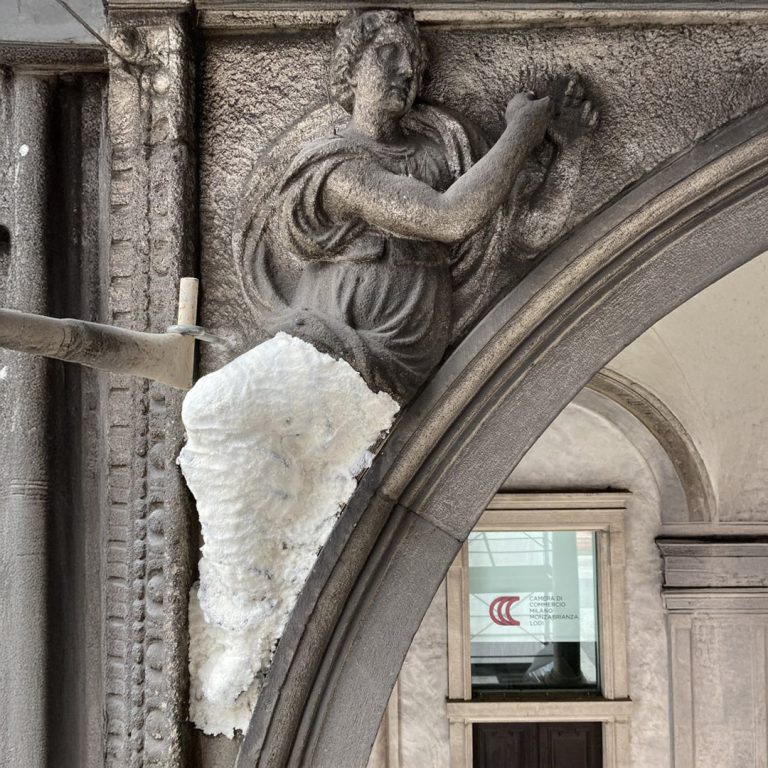
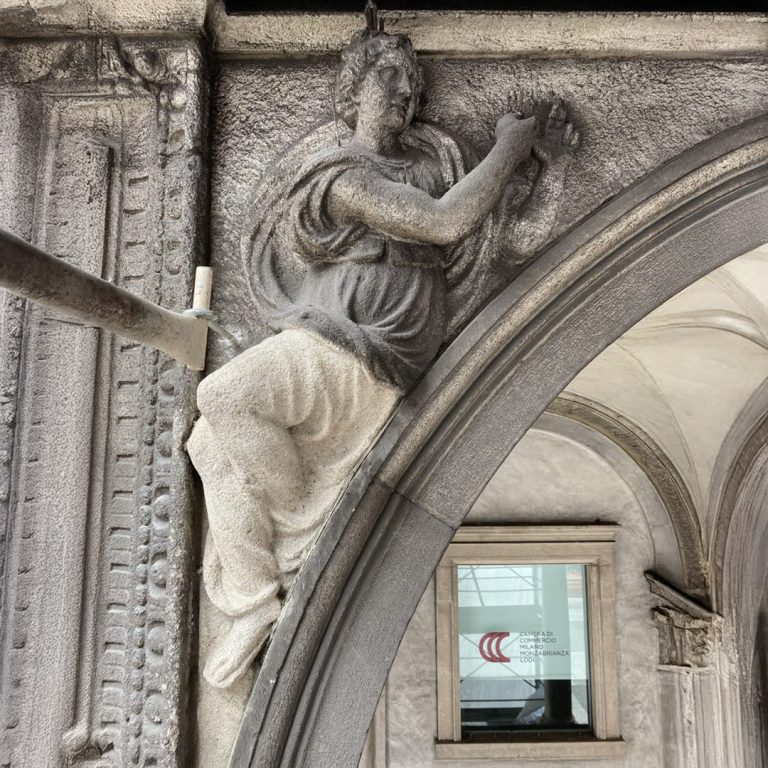
The restoration work was based on the principles of conservation, which presuppose the minimum intervention, the technological compatibility between existing materials and new materials, the tendency to reversibility and the distinction. The moulded stump surfaces have been treated very accurately. During the cleaning phase, the use of ammonium carbonate packs was opted for to convert the plaster present in a soluble compound, then mechanically removed with great precision. The consolidation was carried out with di-ammonium phosphate (DAP), an inorganic product, more compatible with other products with the litotype. To facilitate penetration, the DAP was applied in two stages, with increasing concentration, with the addition of benzalkonium chloride (BAC) as a biocidal product. This same principle was also adopted in the protection phase, where ammonium oxalate, enriched with BAC, was used to ensure its preventive effectiveness against microbial proliferation. Sealing and plastering were only carried out after these operations, to avoid chromatic changes.
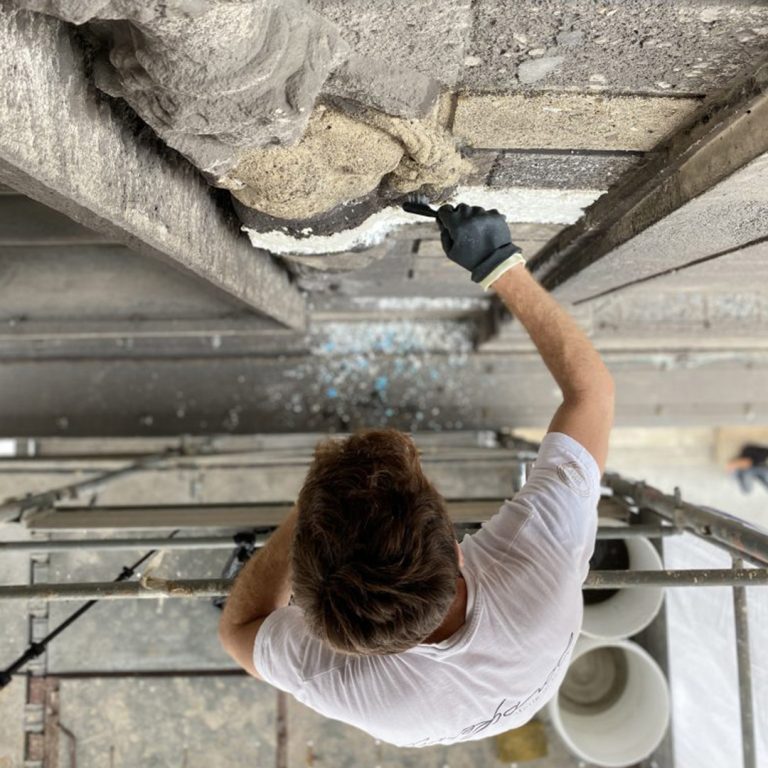
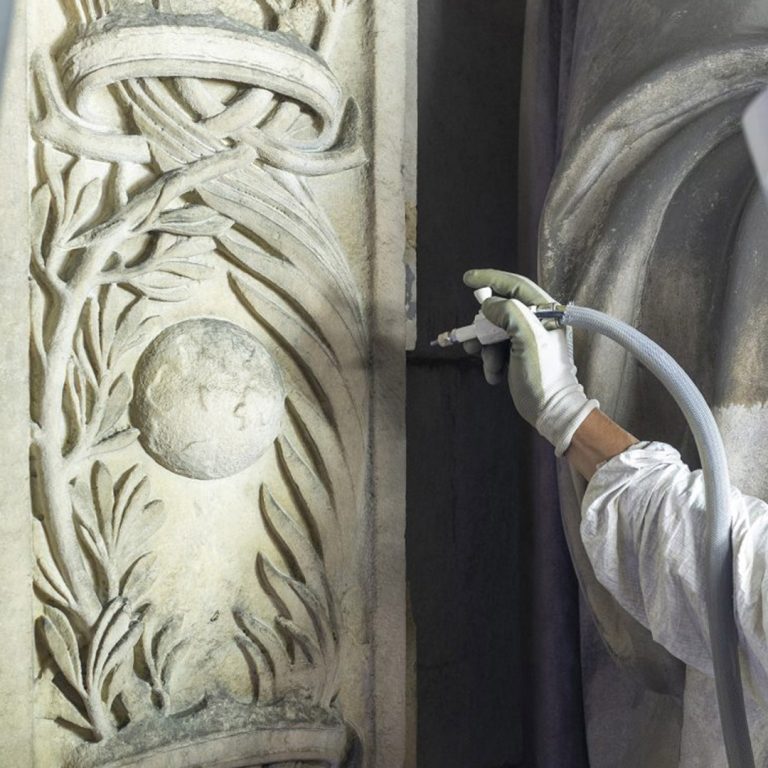
For unmodelled Chopper surfaces, cleaning included gentle washing with deionized water and brushing, possibly integrated with micro-erasing with calcium carbonate at 100 μ and 1.5 bar pressure for the most resistant crusts. The fillings were made with natural hydraulic lime mortars and deep injected acrylic adhesives. The surfaces in Pietra di Viggiù have been protected with silossans applied by spray.
The statue of Sant’Ambrogio in Marble of Candoglia has been the subject of a very precise treatment: after a first more generalized cleaning with ammonium carbonate packs, it was done on time with laser cleaning, which allows a selective and precise removal of the crusts if, localized consolidation and protection was provided.
On the plastered surfaces, after beating and removing the no longer recoverable parts and the re-adherence of the detached areas with injections in the interface between plaster and masonry, adsorbent packs were performed to eliminate soluble salts. On the areas with capillary rise, after removal of the plaster, a potassium propylsiliconate product was applied to contain the formation of salts, and a new macroporous plaster was prepared. The final coloring was made with a product based on silica sol, containing titanium dioxide, capable of neutralizing harmful gases thanks to its photocatalytic action.
Other interventions concerned the maintenance of the windows, treated with a pigmented alkyd resin finish with natural earths, the repair of the covers, the installation of a lifeline (to encourage safe maintenance) and an anti-volatile electrostatic system.
Among the main methodological innovations of the project, the extensive use of the BIM model for the information management of the project and the site, the use of drones and digital photogrammetric techniques for the production of orthophotos, the adoption of inorganic products (DAP and AmOx) as consolidating and protective, more compatible with the products most in use with the stone materials present and in relation to their state of degradation. Also important is the use of laser technology for cleaning the statue of St. Ambrose and the use of photo-catalytic paintings for the coloring of plastered surfaces. Finally, the project stressed the importance of the maintenance criterion, promoting strategies to facilitate future maintenance of the building and slow down the recurrence of degradation.